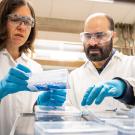
Thousands of times per year, a family’s moment of joy turns to unexpected grief. A seemingly healthy infant stops smiling or making eye contact. Their limbs grow weak. The tiny child suffers seizures and breathing problems.
Jawdat Al-Bassam, an associate professor of molecular and cellular biology at the University of California, Davis, often hears from these families. “I’ve gotten emails from folks all over the world,” he said.
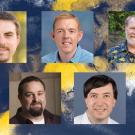
Four faculty from the University of California, Davis, have been elected as Fellows of the American Association for the Advancement of Science, class of 2025. They are among nearly 500 scientists, engineers and other innovators that the society recognized this year for their scientifically and socially distinguished achievements.
Here are the new fellows, with their fellowship citations:
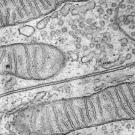
Inside our cells are tiny engines that supply the energy to sustain life. These protein machines essentially burn our food – producing CO2 and harnessing the energy that is released to sustain growth, movement and even thought.
Each year, roughly 1.6 million people worldwide are born with genetic diseases that disrupt these tiny cellular engines – making life difficult.
“Mutations in these protein complexes are really devastating, and often lethal,” says James Letts, an associate professor of molecular and cellular biology.
In a new study published in Science Advances on September 10, a team of UC Davis researchers tracked the movement of fluorescent particles inside the cells of microscopic worms, providing unprecedented insights into cellular crowding in a multicellular animal. They found that the cytoplasm inside the worms was significantly more crowded and compartmentalized than in single-celled yeast or mammalian tissue culture cells, which are more commonly used to gauge internal cellular dynamics.
Although teaching is a core part of being a professor, most academics learn how to teach on the job. CBS’s Future Undergraduate Science Educators (FUSE) program is changing that.
Sam Arcement—Director of Graduate Academic Programs for the College of Biological Sciences, and the program coordinator for the Molecular, Cellular, and Integrative Physiology (MCIP) Graduate Group—has been honored with the 2024 Outstanding Graduate Program Coordinator Award from the Office of Graduate Studies. This year saw a record number of nominations. “Sam tirelessly ensures that our needs and concerns are heard and addressed,” said one MCIP student, who praised Arcement’s dedication to student advocacy.
Commitment.Passion. Empathy. These descriptors were just a few of the plaudits the winners of the 2024 Graduate Program Advising and Mentoring Award received in their nomination letters.
“[This professor’s] mentorship is always the perfect balance of pushing you to your full capacity, while also supporting at a level that fosters independence, creativity and self-ownership.”
“[This professor] combines a deep sense of empathy with a steely commitment to student development.”
Funding agencies and universities should make it more equitable for early-career investigators with non-traditional career paths to compete for grants and progress in their careers, argue four scholars with non-traditional backgrounds in a paper published in PLOS Biology in the fall of 2023.
Many mammals, from domestic cats and dogs to giant pandas, use scent to communicate with each other. A new study from the University of California, Davis, shows how domestic cats send signals to each other using odors derived from families of bacteria living in their anal glands. The work was published Nov. 8 in Scientific Reports.