UC Grad Slam is an annual contest in which master’s and Ph.D. students across UC campuses compete to sum up their research for a general audience. Learn more about Grad Slam Finalist Katherine Murphy, a plant biology graduate student.
Vince Buffalo graduated from UC Davis with a B.A. in Economics and Political Science. Today, he studies evolutionary and population genetics in the lab of Professor Graham Coop. Find out how he traded macroeconomic models for genome sequencing.
On Thursday, Feb. 28, the College of Biological Sciences will host the Nara Institute of Science and Technology Mini-Symposium, which will feature talks on parasitic plants, chimeric animals and the molecular mechanisms of central nervous system formation, among other topics. The symposium will be held in Life Sciences 1022.
In a study appearing in PLOS Genetics, Professor Sean Burgess and her colleagues highlight how mutations in a gene called spo11 can lead to zebrafish males that are infertile and females that produce offspring with developmental problems.
Katherine Dahlhausen's microbial curiosity was inspired by a rare bacterial disease she contracted while traveling in South America. Today, she's a graduate student in Professor Jonathan Eisen's lab exploring things like koala poo, chlamydia and the microbiome.
Since enrolling at UC Davis, Ecology Graduate Student Grace Ha has studied eelgrass through the lenses of ecology and natural history. She currently researches the role camouflage plays in these beds.
In the last year, the Young Scientist Program has engaged roughly 1,100 students across the San Joaquin and Sacramento counties, bringing science education with a flair to underserved and poverty-stricken communities in the region.
Claudio Monteza-Moreno spent his adolescence exploring the ecosystem behind his childhood home in Panama. These experiences opened his mind to science and eventually brought him to UC Davis. Today, he’s a student in the Animal Behavior Graduate Group.
Seeking a better understanding of limb regeneration, UC Davis researchers are studying the relationship of redox players, like oxygen and hydrogen peroxide, with bioelectricity, including membrane potential and electric currents, to pinpoint how a tadpole can regrow an amputated tail.
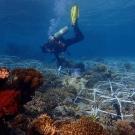
Even after being severely damaged by blast fishing and coral mining, coral reefs can be rehabilitated over large scales. In a new study, researchers installed 11,000 small, hexagonal structures called “spiders” across 5 acres of reef in the center of Indonesia’s Coral Triangle.