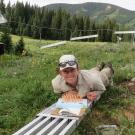
A small, short-lived mountain wildflower is providing clues to understand the larger threats of species extinction as the climate warms. In a new study from Science Advances, UC Davis alumna Anne Marie Panetta, ’17 Ph.D. in Ecology, used historical surveys and experimental data to demonstrate that climate warming contributes to a reduction of biodiversity in ecosystems.
For more than 35 years, scientists have tried to isolate embryonic stem cells in cows without much success. Under the right conditions, embryonic stem cells can grow indefinitely and make any other cell type or tissue, which has huge implications for creating genetically superior cows.
Founded in 2015 by Distinguished Professor Pamela Ronald, Plant Pathology and the Genome Center, Science Says started as a project funded by the UC Davis Institute for Food and Agricultural Literacy to combat misinformation in food science. Since then, it’s grown into a campus-wide student group.
Did you ever pass an orchard with branches bursting with flowers and wonder how the trees “know” when to blossom or bear fruit all at the same time? Scientists from the University of California, Davis, have given such synchronicity considerable thought.
In a new study appearing in Developmental Cell, Ruensern Tan, a biochemistry, molecular, cellular and developmental biology graduate student, and Assistant Professor Richard McKenney, Department of Molecular and Cellular Biology, provide a new molecular model to describe the role of motor proteins in restructuring the cytoskeleton for cell division.
Some Antarctic fish living in the planet’s coldest waters are able to cope with the stress of rising carbon dioxide levels in the ocean. They can even tolerate slightly warmer waters. But they can’t deal with both stressors at the same time, according to a study from the University of California, Davis.
When Briana Rocha-Gregg was young, her dream of becoming a scientist didn’t seem like a possibility. The path to higher education was untrodden and unfamiliar to the Stockton, Calif. native. She had no tangible examples of people with a college education in her life. To Rocha-Gregg, practicing science seemed like a privilege only open to special people.
“Even at community college, I had a counselor tell me that I was wasting my time trying to be a scientist because I was a mother, and it wasn’t really feasible to balance those things,” said Rocha-Gregg.
The annual “Butterfly for a Beer” contest, sponsored by Art Shapiro, distinguished professor of evolution and ecology at the University of California, Davis, gets underway on Monday, Jan. 1. The person who collects the first cabbage white butterfly (Pieris rapae) of the year in one of three counties—Sacramento, Yolo and Solano—will receive a pitcher of beer or its equivalent.
An international team of researchers has identified a cause for chronic bad breath (halitosis), with the help of gene knockout mice from the UC Davis Mouse Biology Program. The results are published Dec. 18 in the journal Nature Genetics.
Richard Addante studies the neurophysiology of human memory. He recently joined up with NASA to study and better understand the effects of long-term spaceflight on the brain, body and team dynamics, of which little is known.