Biofuels are an important part of the broader strategy to replace petroleum-based gasoline, diesel, and jet fuels that we use today. However, biofuels have so far not reached cost parity with conventional petroleum fuels.
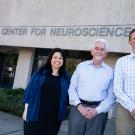
At the UC Davis Center for Neuroscience, researchers collaborate in state-of-the-art facilities to find solutions to help treat, prevent and cure brain conditions, like schizophrenia, autism, depression and Alzheimer’s disease, among others.
The popular painkiller ibuprofen may have more significant effects on the liver than previously thought, according to new research from the University of California, Davis. The study in laboratory mice also shows marked differences between males and females.
Some species of fish, notably parrotfish and wrasses living on coral reefs, change their biological sex as they age, beginning life as females and later becoming functionally male. New work from the University of California, Davis, shows that this sequential hermaphroditism evolves when bigger males gain an advantage in reproductive success.
For years, Animal Behavior Graduate Group student Alexandra McInturf has traveled to Ireland to investigate the behaviors of basking sharks. Though they’re the second-largest fish on the planet, this leviathan is shrouded in mystery.
Chancellor Gary S. May and Mark Winey, dean of the College of Biological Sciences, recently cut the ribbon on a new cryo-EM facility in Briggs Hall. The $2.5 million microscope is open to all campus researchers. It can collect thousands of images a day to assemble into movies showing how proteins and other biomolecules do their work.
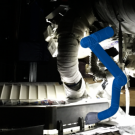
A team of UC Davis researchers look to give humanity an extra hand—literally. A new, NSF-funded collaboration between the Departments of Mechanical and Aerospace Engineering (MAE) and Neurobiology, Physiology and Behavior (NPB) plans to develop and test a robotic fifth limb to give humans extra capabilities in extreme environments.
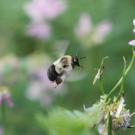
Bumblebees are the big lifters of the insect world, able to fly back to the hive with almost their own body weight in nectar on board. A study published Feb. 5 in Science Advances shows how they do it — and that bees can show more flexibility in behavior than you might expect from a bumbling insect.
The origin of photosynthesis is a tale of biological thievery that started billions of years ago. In this comic, Distinguished Professor John Clark Lagarias walks us through this tale.